This week I was able to watch the end of a netball tournament played by one of the girls I babysit for who is ten years of age. As I observed the last few minutes of the young girls playing, I noticed that netball had a much more relaxed atmosphere than many of the other sports I have seen so far in Australia. While at the nippers and rugby sporting events the parents I observed not only seemed incredibly involved but were also constantly pushing their children to play well, at the netball tournament the majority of adults seemed to be calmly enjoying themselves, removed from the tournament, as they watched the girls play. Most of the parents were casually talking on the sidelines, or positively encouraging their daughters as they played. When I talked with the parents of the family I babysit for, they told me that netball was an excellent sport to be involved in for young girls, one that is a lot of fun but also very challenging and competitive. Watching the girls play, I certainly noticed that they were having a good time and also noticed that they were all incredibly driven. Even though the girls had been playing for hours when I arrived, they still continued to play their hardest. After finishing the last game, the ten-year-old I babysit for told me that it was her first time ever playing netball and that even though she lost the majority of her games that day, she was very excited to continue playing for the rest of the season. She also told me how along with netball, she and her two siblings participate in a track and field-like sport once a week and play soccer as well. From observing the end of the netball tournament and talking with the family about their involvement in sport, I could clearly see that sport played an undeniably important role in both their individual and family lives – a powerful reflection of Australian culture in a young Australian-American family.
Thursday, April 14, 2011

Wednesday, April 6, 2011
Cricket at Sydney Olympic Park & on Television
This past Saturday I went to the Sydney Olympic Park and observed countless families playing cricket on the open grassy areas. I watched one game in particular where parents or older children threw the ball to younger children who then made their best attempts at swinging to hit the ball as far as they could. While some played cricket, others cooked and talked as they either ate barbeque or picnic foods. Watching this, I was reminded of barbeques in America where many families gather to talk, eat and play a game of wiffleball – a game strikingly similar to baseball but the bat and ball used are both made of plastic. From my experience at Sydney Olympic Park, I realized that sport in Australia is not only practiced in a competitive and professional setting but also in a family and leisurely context, one that is very similar to American recreational sport. Over the past two months, I have also watched cricket numerous times in both restaurants and bars. Viewing cricket matches on television reminded me a lot of watching professional golf because both games are very slow-moving and highly based on skills. Tatz (2011) explains how cricket was once used as “a civilizing force in some colonies” (Tatz, 2011, p. 139) in Imperial Britian by encouraging positive behavior and is now a sport most often played by the elite. Similarly, golf is a game with a written code of etiquette which demands good behavior and golf is most often played by wealthy individuals who work in the business world. Although I do not yet understand all of the rules of cricket, from my experience seeing cricket recreationally at Sydney Olympic Park and professionally on television I can tell that it is comparable to both baseball and golf in America. I hope that while I am in Australia I will be able to see a professional cricket game live, and learn more about the Australian cricket culture!
Sunday, April 3, 2011
Roosters vs. West Tigers Rugby Game
This Sunday afternoon I went to the Roosters vs. West Tigers game at the Sydney Football Stadium. After navigating through a sea of red, navy and white, I found seats near the Roosters’ goal post. I was surrounded by families and was shocked by how many young children I saw watching the rugby game. All of the children seemed to know exactly what was going on in the game, standing up to cheer for their team at the right times and expressing distress when the opposing team nearly scored. One child about four years of age sitting two seats away from me stood up on his seat and yelled, “Boo Tigers!” as he shook his thumb downwards at another fan walking by.
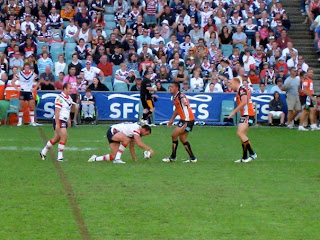
Not only was this quite hysterical to witness, but it also showed me how important sport is in Australian culture and how children are exposed to sport at a very young age. Being amidst the crowd of families reminded me of attending an afternoon Red Sox game at Fenway Park in Boston where many Bostonians like to bring their families to relax and enjoy some ballpark food while cheering the Sox on. Looking across to the other side of the stadium at the rugby game, however, the fans appeared to be incredibly rowdy, all of them dressed in their team’s colors waving flags in the air and chanting very loudly. Seeing this fan section reminded me more of watching the Patriots play at Gillette Stadium where young and old adults gather to drink beer and excitedly – and at times rudely – cheer on the Patriots. Although the stadium was not full, I could clearly see that the Rugby League has an incredibly loyal fan base beginning at a very young age and ending at a very old age. I was very happy to be able to attend a Rugby League game which was not only an extremely fun but also an incredibly cultural experience!
Thursday, March 24, 2011
Newtown Public Primary Physical Education Class
This week I observed a gym class at the primary school I volunteer at every week called Newtown Public. Because of the integral role sport plays in the lives of Australians I expected the class to be much different from the gym classes I partook in during elementary school in America. The class I observed had a session on gymnastics in which the kids were required to do handstands and walk on balance beams. In my schooling experience gymnastics was not a part of the physical education curriculum but only a sport practiced outside of school by those who had enough money to participate. I found it incredibly interesting that gymnastics are practiced in Australian physical education classes not only because it has never been a part of American physical education but also because it is not one of the sports Australians pride themselves on. Another difference I noted between Australian and American physical education by talking with the teacher after class was that Newtown Public School does not have a separate physical educator but instead the classroom teachers run physical education for their individual classes, a trend becoming common in Australian schools. Light (2011) emphasizes this point by stating that “there had been a significant decline in the content and quality of physical education and sport in schools linked to a reduction in the number of specialist physical education teachers” (Light, 2011, p. 61) in the late 1980s. In this article Light (2011) further describes how physical education has become less effective in the past few generations because it is now packed into a stacked curriculum that emphasizes academics. This same problem has recently occurred in the United States, as limited budgets have cut back on physical education and at times cut physical education out of the curriculum entirely. I believe that physical education proves crucial to child development and helps combat childhood obesity, and therefore think that both Australia and the United States need to maintain strong physical education programs in all elementary schools.
Wednesday, March 16, 2011
Surf Lessons in Australia

Sunday, March 13, 2011
The Nippers at Maroubra Beach

Today we traveled to Maroubra Beach where I had the opportunity to observe children ages six and seven participate in the Nippers. I saw these children race both in the sand and in the water, as parents encouraged them by clapping and cheering on the outskirts. I noticed that there was one man running the races by yelling out instructions and blowing his whistle to signal the start of each event. From lecture I had learned that the Nippers was a community sport run by volunteers, and saw this play out at Maroubra as I observed the man running the races asking for parent volunteers to stand at both the start and finish lines. I also spoke to one of the parents who explained to me that at this age the children were not competing but were only training to get use to the water and participating for fun. He told me that the kids really enjoyed it, and that the parents had fun serving as volunteers within the Nippers community as well. As I continued to watch the children and speak with parents, I thought of how much the Nippers community reminded me of my junior softball league in the United States. In this little league almost all of the coaches were parents of children on the teams and the assistant coaches were always parent volunteers. Parents also came to every game to cheer their children on and rotated bringing snacks for the players to eat after the game. Parents and children participate in this league because of their love for the sport, for their own enjoyment and for their community participation, all of which fuel the volunteer-based Nippers in Australia. Despite these similarities, the Nippers is also very different from any sport I have seen in America because learning water safety is not as crucial and water sports are not as common due to differences in geography and climate. I loved watching the kids have fun learning about water safety and observing the liveliness of the Nippers community and look forward to my future Australian sport endeavors!